If you’ve ever felt a dull, tightening pain creep from the base of your skull to your temples, you’re not alone. Tension headaches are a very common complaint, and while they’re often blamed on stress, the real story is more psychophysical than many people realize. From an Alexander Technique perspective, these headaches frequently begin with the stress response manifesting in the neck.
As an Alexander Technique teacher, I see this daily. Someone comes in frustrated, having tried pain relievers, massage guns, and peppermint oil. They assume the headache is a "brain problem." But more often than not, the true culprit is hiding at the very top of the spine.
Here is the anatomy of why your neck is the control centre for tension headaches, and how to change the habit.
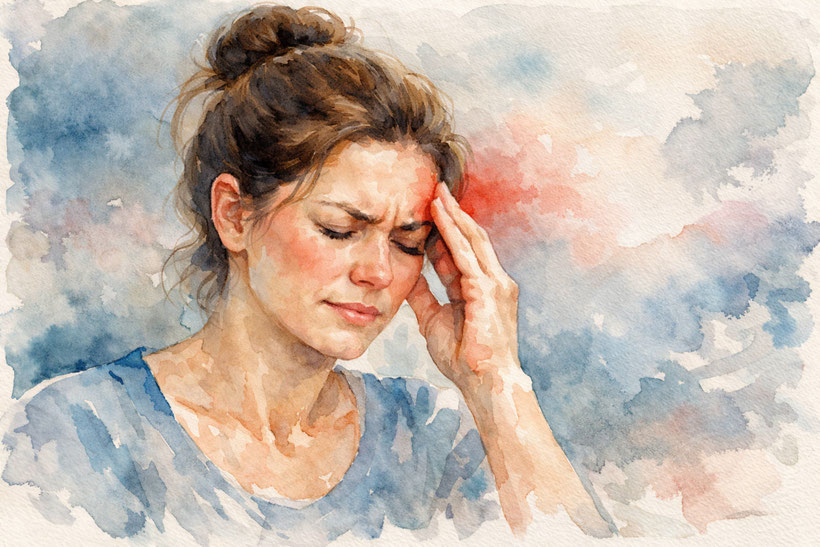
The Neck: A Critical Crossroads
Your neck isn’t just a stack of bones holding up your head, it’s a finely balanced, highly responsive system of muscles and joints that coordinates with the entire body. The head weighs around 4–5 kg (10–12 lbs), and when it’s well-balanced on top of the spine, the neck muscles don’t have to work very hard.
But here’s the catch: most of us aren’t using this system efficiently.
Your skull sits atop the spine on a tiny, ring-shaped bone called the Atlas (C1). This joint is responsible for the "yes" nod of your head. Just below it is the Axis (C2), which handles the "no" shake.
Right next to this delicate junction lies the Trigeminocervical Nucleus, a fancy name for a very important relationship. This is the brain’s relay station for pain signals coming from both the face/head (the trigeminal nerve) and the neck (the cervical nerves).
Because these wires cross in the same box, your brain gets confused. If your neck muscles are screaming, "I’m tight! I’m straining!" the brain often reads that signal as a headache in the forehead or temples. It’s referred pain.
In short: A stiff neck doesn’t just cause a headache. It becomes the headache.
When the head is pulled slightly "back and down", a common habit when sitting at a desk, looking at screens, or even “trying to sit up straight”, the neck muscles tighten to hold it there. This subtle misalignment increases compression in the upper spine and creates a cascade of unnecessary muscular effort.
How Tension Builds, The Downward Pull.
Over time, this chronic tightening, especially in muscles like the suboccipitals (at the base of the skull), upper trapezius, and sternocleidomastoid, can restrict blood flow and irritate surrounding nerves.
The result? That familiar band-like pressure around the head.
What’s important here is that the headache is often a secondary effect. The primary issue is the ongoing misuse of the neck; tightening, bracing, or shortening it without awareness.
Why does the neck get tight in the first place? It’s rarely an injury. It’s a habit.
F.M. Alexander, the founder of the Technique, called this relationship between the head, neck, and back the "The Primary Control." When this relationship is balanced, the muscles can release. When it’s compressed, everything tightens.
Look at your posture right now. Are you thrusting your chin forward toward the screen? Are you collapsing your chest and pulling your head back into your shoulders?
When you consistently pull your head back and down the suboccipital muscles, tiny muscles at the very base of the skull, go into spasm. They also pull on the dura mater (the lining of the brain), helping to trigger that band of pressure we call a tension headache.
The Role of Habit
One of the key insights of the Alexander Technique is that much of this tension is habitual. We don’t consciously decide to stiffen our necks, it happens automatically, often in response to stress, concentration, or even the intention to “perform well.”
For example:
- Leaning forward into a laptop
- Clenching the jaw while thinking
- Pulling the head back when trying to “correct posture”
These patterns become so familiar that they feel normal, even when they’re creating strain.
The Vicious Cycle
Here is the cruel trick of tension headaches:
- Stress arrives (a deadline, traffic, an argument).
- You unconsciously pull your head down and back to brace yourself.
- The neck muscles tighten, triggering the headache.
- The headache hurts, so you try to hold your head still and brace against the pain.
- Bracing tightens the neck even more.
You are essentially holding the headache in place.
How to Stop It (The Alexander Solution)
You cannot relax your way out of this by lying on your sofa, stretching or massaging the neck (which can provide temporary relief), you need to change how you use your Self in activity as a daily habit.
A key principle is allowing the neck to be free, meaning not rigid, not held, and not compressed. When the neck is free:
- The head can balance more easily on the spine
- The back can lengthen and widen naturally
- Muscular effort throughout the body decreases
This isn’t about “holding good posture,” but about stopping the habits that interfere with natural coordination. Good posture isn't a rigid position but a fluid and dynamic relationship with the ground. It's the most efficient way to use yourself and therefore takes the least effort.
Next time you feel the pressure building, try this thinking exploration (do not force or stretch):
- Pause. Stop what you are doing. Don't try to "correct" your posture. Just notice the tension.
- Think "Up." Allow that thought to release the downward pull. Do not lift your chin. Just think of a subtle upward release. It's a pure intention, what we traditionally call Directing in the Alexander Technique.
- Allow your head to go FORWARD and UP. This is the secret, creating an undeniable intention. A compressed neck is usually "back and down." You want your head balancing delicately on top of the spine. Let your nose release slightly toward the floor as the crown of the head releases up.
- Keep renewing your intention as you take it into activity.
This isn't a stretch. It’s an inhibition. You are saying "No" to the habit of pulling down, and "Yes" to the natural poise of your skeleton.
Practical Awareness
You might begin simply by noticing:
- Are you pulling your head back as you read this?
- Is your chin jutting forward toward the screen?
- Is there a sense of gripping at the base of your skull?
Rather than trying to fix anything, see if you can pause and allow a small release, letting the head gently balance, the neck soften, and the shoulders drop without forcing them.
Even a few moments of this kind of awareness can interrupt the cycle of tension.
The Bigger Picture
You cannot cure a tension headache by rubbing your temples. You have to go to the source: the neck. And you cannot change the neck by forcing it into a "good posture." You have to change the relationship between your head and spine and their relationship to the support from the ground. Posture is a pro-gravity system. Your posture and your neck receive support from the ground, you don't have to create it.
Tension headaches aren’t just about stress, they’re often the result of how we physically respond to stress, thought, and activity. Next time the vice tightens, don't fight the pain. Stop pulling your head down into your body. Let the head release up (an undoing), and watch the tension in the neck, and the resulting headache, begin to dissolve.
Have you noticed your headache start in the back of your skull before it moves forward? That is your neck sending the distress signal. Listen to it.
By learning to reduce unnecessary tension at this key point, you’re not just addressing headaches, you’re improving your overall coordination, breathing, and sense of ease.
And that’s where lasting change begins.
Write a comment