Core Principle: You are not "fixing" your posture, but rediscovering your natural, balanced support by letting go of harmful habits.
The Misconception
Most people think good posture is about pulling your shoulders back, lifting your chest, and straightening up through effort. This creates rigidity and compression. The Alexander Technique offers a different approach: it's about inhibition (stopping the unhelpful habit) and direction (allowing your natural poise to return). However we choose to define "good posture", it is fundamentally the most economical way of using yourself, and therefore requires less effort than the habits that take you away from it. There may be a period of muscular readjustment as previously underused muscles are activated. They don't need to be strengthened through isolated exercises, they will adapt naturally to the new coordination.
The Process: Thinking in Activity
1. The Pause (Inhibition)
Before any action (sitting, standing, walking), pause. This breaks the automatic, habitual reaction. Don't try to "do" good posture. Just stop. And observe. You won't find more ease by "trying". This is a learning phase until it becomes second nature, or you notice an activity that encourages excess effort.
2. The Primary Directions (Non-Doing)
These are gentle, expansive thoughts that allow your body to reorganize. They are not physical commands. In your pause, think these intentions softly to allow yourself to reorganise:
- "Let my neck be free." This is the master key. Any tension in the neck pulls the head off balance and compresses the spine.
- "To allow my head to go forward and up." Not "tuck your chin" or "lift your head." "Forward" is a rotational forward release at the atlanto-occipital joint (where your skull meets the top vertebra) that generates length up the back of the neck. It encourages a release into length along the whole spine.
- "To let my torso lengthen and widen." Think of your back broadening across your shoulder blades and your spine gently decompressing, like a coiled spring finding its full, relaxed length.
You don't "make" these happen; you simply allow the intention to follow through to allow the body to reorganise.
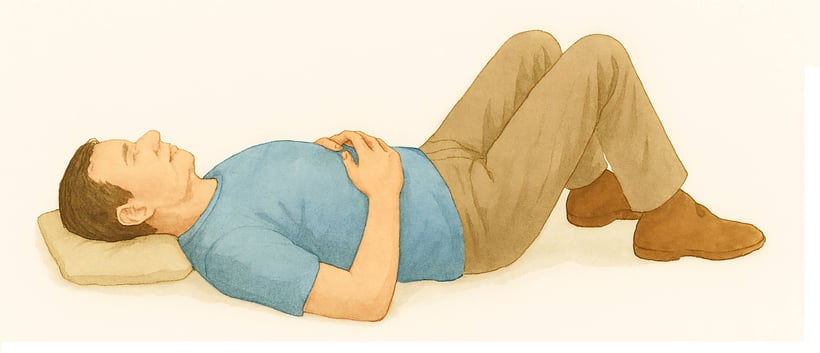
A Simple Daily Practice: Constructive Rest (10-15 minutes)
Also known as lying in semi-supine, This is the best way to let go of accumulated tension and reorganise your thinking.
- Lie on your back on a firm surface (carpeted floor or yoga mat). Place a small, firm book or two under your head so it is in a neutral position, not tipping back or tucking forward. Bend your knees, with feet flat on the floor, hip-width apart, knees pointing to the ceiling.
- Let your hands rest gently on your lower ribs or abdomen.
- In this position, gravity supports you. You don't have to hold yourself up.
- Apply the Directions: Gently think through the sequence:
- · Notice the contact with the floor. Allow the weight to sink.
- · "I wish for my neck to be free..."
- · "...so that my head can go forward and up..."
- · "...and my torso can lengthen and widen..."
- · "...and my knees can release towards the ceiling..."
Don't "do" anything. Just notice sensations and think the directions as a strong intention. When your mind wanders (it will), gently bring it back to the thought of a free neck. You are practicing conscious, constructive thinking to reduce habits of contraction that interfere with natural functioning and coordination.
Applying it in Activity: Sitting Down & Standing Up
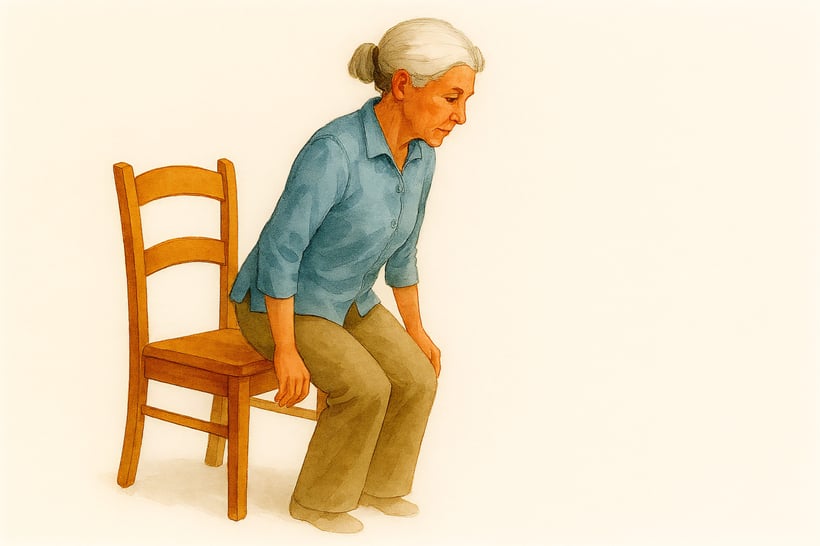
Sitting Down (The Alexander Way):
- Pause in front of the chair. Have the intention to sit, but don't collapse.
- Think: "Neck free, head forward and up." i.e. don't pull on your neck muscles
- Allow your knees to bend first, as if you are lowering yourself into a squat by hinging at your hip, knee, and ankle joints. Your head continues leading "forward and up" over your feet.
- Find the chair with your sit bones. You haven't "plopped." You've guided yourself down with control and length.
Standing:
- Pause. Don't lunge forward.
- Think your directions.
- Hinge forward from the hips whilst keeping your legs relaxed, until you feel the weight transfer from your sit-bones to your legs. Only at this point do you make the decision to stand by pushing the floor away through your heels. In time you will be able to do this as one flowing movement.
Key Mindshifts
- End-Gaining vs. Means-Whereby: Stop focusing solely on the goal (e.g., "I must sit straight"). Focus on the quality of how you get there (e.g., "I will move with a free neck and a lengthening spine").
- Faulty Sensory Awareness: Your current "feel" of right posture is likely distorted by habit. What feels "straight" may be stiff. Trust the process, not the immediate sensation.
- Use Affects Function: Your posture isn't separate from your actions. It is how you use yourself in everything you do. Improve the use, and the posture follows.
Final Thought
The Alexander Technique is a re-education of your mind-body unity, a neuromuscular reboot. It is subtle and powerful. Improvement comes not from adding things to do correctly, but from subtracting the unnecessary. Start with the Pause and the Primary Directions. Be patient. You are undoing a lifetime of habit as much as building a new one.
"You translate everything, whether physical, mental or spiritual, into muscular tension." – F.M. Alexander
Begin by observing yourself without judgment. Notice when you tighten. Pause. Think your directions. And allow a new, easier way of being in your body to emerge.
Write a comment