We've all been there. Staring at a tricky passage, fingers tensed, mind laser-focused on that next note or chord. We tense, we lunge, we grit our teeth... and often, we stumble. OK, slight overkill, but you get the idea. The note might be hit (eventually!), but it sounds forced, the rhythm wobbles, and our shoulders feel like they're up around our ears.
We spend hours drilling scales and chord shapes, focusing on the notes themselves. We aim for them, we land on them, and we hold them. But what about the journey between them?
As an Alexander Technique teacher, I see this regularly, the guitarist who is so focused on the destination (the note) that they forget about the journey (how they get there). In Alexander terms, this is the classic trap of "End-Gaining."
The End-Gaining Trap: Aiming for the Bullseye
Most of us are natural and inveterate "end-gainers." We fixate on the result – hitting that high C on the 20th fret, nailing that Bm11 chord change on the beat. Our entire system gears up for that specific destination. We contract muscles unnecessarily, hold our breath, and often pull our head down towards the fingerboard in a desperate attempt to "aim" better.
End-gaining is fixating on a goal without paying attention to the quality of the process. On the guitar, it looks something like this:
- Staring intently at the fretboard, mentally yelling "GET TO THE HIGH C!"
- Gripping the neck with a death grip for "security."
- Locking your shoulders and holding your breath as you make a difficult reach.
- Sacrificing tone, rhythm, and ease just to arrive at the note, no matter the cost.
The result? Tense, choppy, and unreliable playing. It’s the musical equivalent of a car journey where you only care about the destination, so you slam on the accelerator and then jam on the brakes at every red light. It’s inefficient, stressful, and hard on the machinery (in this case, your body).
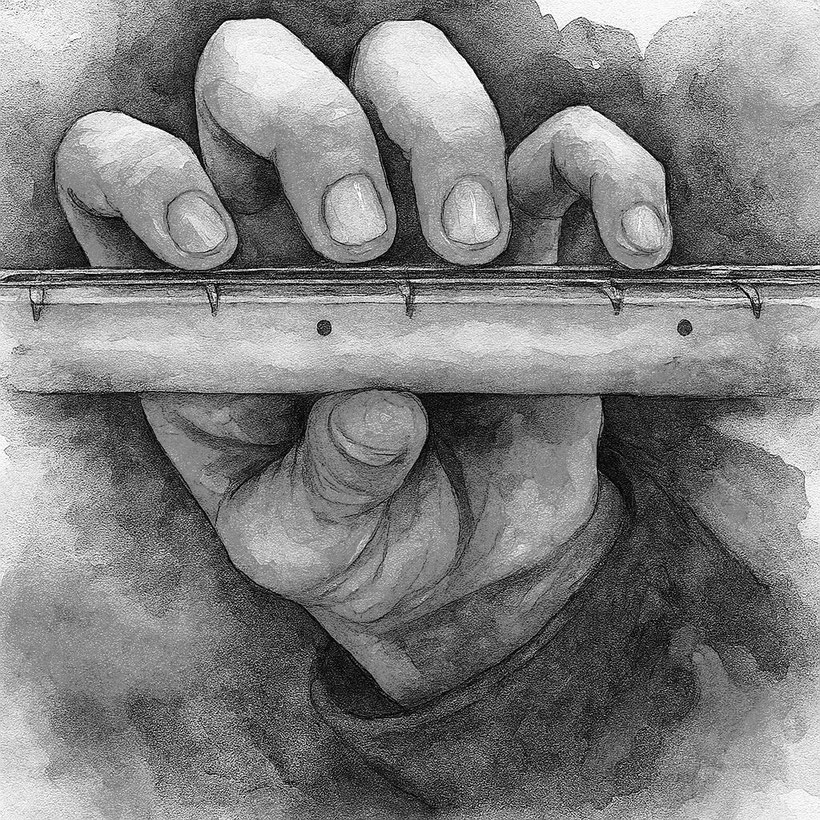
The Musical Alternative: The "Means-Whereby"
The Alexander Technique teaches us to shift our focus from the end (the note/chord) to the means-whereby we achieve it. The process, the journey, the quality of movement in between. This is revolutionary for guitar playing.
Think about it, anyone can play one note fast. The true challenge of technique is getting gracefully from one note to the next. And that means your rhythmic skills, the most fundamental aspect of music, are also to be found in the transitions.
The space between the notes isn't empty, it's where your technique and rhythm lives. It's where your fingers find their new positions, your pick changes direction, and your body organizes itself for the next move. When you focus on the means-whereby, you stop treating the notes as isolated targets and start treating music as a continuous, flowing stream of movement.
: Instead of forcing your fingers with mental commands, use Alexander-style "." These are gentle thoughts that encourage ease and coordination and prioritises your general functioning, which always precedes specific functioning: "Neck free, head forward and up, shoulders widening, arms releasing away from my back." As you initiate the transition, think the movement path with ease, rather than focusing solely on the destination fret. Direct your whole self, not just your fingertip.
- The Transition Is the Technique: Instead of seeing the space between notes as a problem to be rushed through, recognize it as the very ground where good technique is built. How you release the pressure from one finger, how your hand floats (rather than crashes) to the next position, how your arm guides the shift – this is your technique manifesting.
- "Up and Out," Not "Down and In": When end-gaining, we often pull our head down and contract our torso, collapsing onto the guitar. Alexander principles encourage maintaining an easy, upwardly mobile poise. Think of your head leading your spine upwards, allowing your shoulders and arms to remain free. This creates space for your arms and fingers to move with greater ease and coordination during transitions.
- Inhibition: Pausing the Panic: Before lunging for that next chord, practice a moment of "inhibition." Briefly pause your habitual reaction (the tension, the rushing). Consciously choose not to react with your usual tightening. This creates a window to direct yourself differently.
- Direction: Guiding the Movement: Instead of forcing your fingers with mental commands, use Alexander-style "directions." These are gentle thoughts that encourage ease and coordination and prioritises your general functioning, which always precedes specific functioning: "Let your neck be free, to let your head go forward and up, to let your back lengthen and widen". The most important word in that phrase is "let", it's a reminder of what not to do! And for clarity, the "forward" is the natural rotation forward of the head over the atlanto-occiptal joint. The natural balance of the head on the spine. As you initiate the transition, think through the movement path with ease, rather than focusing solely on the destination fret. Direct your whole self, not just your fingertip.
- The Power of Release: Good transitions rely as much on letting go of the previous note as they do on preparing for the next one. Is your left hand finger still clamped down hard after the note is played? Is your pick hand tensed in anticipation? Practice consciously releasing unnecessary tension immediately after a note sounds, allowing your hand and arm to regain freedom before the next movement begins.
Another way of thinking about this is to play the music, not the notes.
Practical Takeaways for Your Practice
- The "One Note Game": Play a single note. Focus entirely on the quality of releasing it by emptying your intention from your fingers, letting the string push the finger back up like a trampoline. Find freedom returning to the hand, arm and shoulders. Then, consciously choose how you move to the next note. Repeat slowly.
- Slow Motion Transitions: Practice only the movement between two notes or chords, incredibly slowly. Choose a problematic transition, perhaps moving from an open C major to an F barre chord. Play the C chord, and then stop. Before you move, bring your awareness to the transition itself. Pay attention to:
-
- Where does tension creep in first (jaw? neck? shoulder? forearm? specific finger?)
- Is your breath flowing?
- Is your head balancing freely, or are you pulling it down?
- Can you make the movement smoother, lighter, with less effort?
- Is there a "pivot" finger that can remain in place through the transition into the next chord.
- Can you have the fingering of the next chord in place, lightly touching the strings, before you apply pressure to the strings.
- Think "Up" During Shifts: Especially during position shifts or large stretches, consciously think of your head leading upwards as you move your hand. This counteracts the collapsing tendency.
- Right Hand Too! This isn't just for the fretting hand. Picking hand fluidity, the transition from one string to the next, the release after a stroke, the preparation for the next, is equally crucial. I like to define a full pick stroke as starting from light contact with a string, and ending in light contact with the next string to be played. This is especially helpful when crossing strings.
- Non-Doing: Often, better transitions come from removing excess effort rather than adding more force. Can you make that chord change with less muscular work? Trust the instrument and the support of gravity more.
Why Bother? The Payoff
When you shift your attention from end-gaining to the means-whereby, a remarkable things happen. Your technique stops being a series of frantic landings and starts becoming a single, integrated dance.
- Improved Coordination: Good coordination is the hallmark of the means-whereby
- Effortless Speed: Fluidity, not force, creates real speed. Unforced movement is inherently faster than tense, frantic movement.
- Consistency: Your consistency improves because you're programming the pathway, not just the endpoint.
- Improved Tone: Notes speak more clearly when your hands arrive without tension. Chords sound fuller when fingers land together without a crunch.
- Musical Phrasing: Smooth transitions are the essence of legato and graceful phrasing. Music flows through the transitions. Your musicality blossoms because the notes are connected with intention and grace, not desperation.
- Reduced Fatigue & Injury Risk: Eliminating the constant "micro-tensions" during transitions saves enormous energy and reduces strain on muscles and tendons. You prevent injury because you're replacing strain with intelligent, conscious use.
- Presence: You become more aware of your whole self in the act of playing, leading to greater control and musical expression.
Remember, anyone can play a single note fast. The guitarist who masters the transitions, with awareness, release, and coordinated ease, is the one who truly makes music. Stop aiming at the notes. Start paying attention to the graceful journey between them. That's where your most beautiful playing lives. Stop aiming, and start traveling.
This may be construed as a little "Zen", and that's fine. I could have easily titled my book Effortless Guitar, as Zen Guitar (although there's already a book of that name), but I wanted to provide a more practical and down to earth guide. A more philosophical view can, though, be just as practical.
Effortless Guitar, published by GuitarVivo available from Amazon and Audible.
Write a comment
Anthony Smith (Tuesday, 28 October 2025 11:47)
Parkinson’s disease runs in my family, both my father and uncle passed away from it. So, when I was diagnosed, I was scared but determined not to follow the same path. For years, I tried different hospital treatments and therapies, but my condition only worsened. That changed when my neurologist recommended EarthCure Herbal Clinic (www . earthcureherbalclinic . com). I decided to try their natural treatment, and within a couple of months, my symptoms started disappearing. It’s now been three years, and I’ve had no signs of Parkinson’s since. I’m truly grateful to my neurologist and to EarthCure Herbal Clinic for giving me hope and health again. I wholeheartedly recommend them to anyone seeking help for Parkinson’s disease.
Eliza (Tuesday, 17 March 2026 08:59)
I was diagnosed with Parkinson’s disease four years ago. For over two years, I relied on Levodopa and several other medications, but unfortunately, the symptoms kept getting worse. The tremors became more noticeable, and my balance and mobility started to decline quickly. Last year, out of desperation and hope, I decided to try a herbal treatment program from NaturePath Herbal Clinic.
Honestly, I was skeptical at first, but within a few months of starting the treatment, I began to notice real changes. My movements became smoother, the tremors subsided, and I felt steadier on my feet. Incredibly, I also regained much of my energy and confidence. It’s been a life-changing experience I feel more like myself again, better than I’ve felt in years.If you or a loved one is struggling with Parkinson’s disease, I truly recommend looking into their natural approach. You can visit their website at www. naturepathherbalclinic .com
info @ naturepathherbalclinic .com
Eliza (Tuesday, 17 March 2026 09:41)
I was diagnosed with Parkinson’s disease four years ago. For over two years, I relied on Levodopa and several other medications, but unfortunately, the symptoms kept getting worse. The tremors became more noticeable, and my balance and mobility started to decline quickly. Last year, out of desperation and hope, I decided to try a herbal treatment program from NaturePath Herbal Clinic.
Honestly, I was skeptical at first, but within a few months of starting the treatment, I began to notice real changes. My movements became smoother, the tremors subsided, and I felt steadier on my feet. Incredibly, I also regained much of my energy and confidence. It’s been a life-changing experience I feel more like myself again, better than I’ve felt in years.If you or a loved one is struggling with Parkinson’s disease, I truly recommend looking into their natural approach. You can visit their website at www.naturepathherbalclinic.com
[email protected]
Lance Jill (Wednesday, 29 April 2026 16:39)
For years, many people doubted that I would recover from Parkinson’s disease. Even when others lost hope, I refused to give up. I followed my neurologist’s recommendations and used medications such as Carbidopa, Sinemet, and Levodopa. While these treatments provided some temporary relief, my condition eventually worsened, especially by the fifth year. At that point, I decided to explore an alternative approach and tried a herbal program from EarthCure Herbal Clinic( w w w. earthcureherbalclinic . com). I used their treatment for four months, and over that period, I experienced a remarkable improvement in my symptoms. Today, I am grateful for the progress I have made and for discovering another option that worked for me in curing and reversing my PD and all its symptoms completely. I share my experience for those who may be considering alternative paths alongside conventional treatment or without any conventional treatment. Send them a message on "info @ earthcureherbalclinic. com" to get your own treatment for any disease or virus .
Robert Norman (Tuesday, 23 June 2026 16:30)
My Cancer journey might not be relatable to the actual post but I hope it save some ones life, A lot of people are going through chronic disease and some people even think of ending their life but I want you all to know that there is hope. I’m living proof that cancer cells can be cured completely. I did Chemotherapy and my condition didn’t respond to treatment but I never give up because I had faith in God that non-Hodgkin’s lymphoma will take control, My doctor said I had few years or months a list to live but I still didn’t let that discourage me. with all hope lost I started taking nutrition herbs with Acupuncture Formula I purchase from Dr Ofua Ofure,(https://neal-hypooght-scealy.yolasite.com) whatsapp (+2347055955394) or email ( [email protected]) within a period of (6) six weeks I was recovering. Today I am 100% cured, Now I’m cancer free. It’s also crucial to learn as much as you can about your diagnosis.
Michael J Weirsky (Friday, 03 July 2026 21:29)
Good day viewers, I wish to share my testimony with all of you. I have daily 9 to 5 jobs but while I work, I try my luck at playing instant Lotto. On this particular day, I decided to seek help online regarding tips for winning the lottery and I saw many individuals testifying about Meduza spells. I reached out to him and informed him that I needed help to win the lottery and he clarified the process to me stating that after he casts the spell, it will take 48 hours for him to provide me the winning numbers which I accepted. I followed all his instruction and he provided me with the numbers to enter the Lottery. After the draw the following morning, I received a notification on the Lottery app on my phone indicating that I was the lucky winner of $273 million on the New Jersey Lottery and I'm here to extend my heartfelt gratitude to Meduza. If you seek for help in any aspect of your life, Whats_App +1 (807) 798-3042 or Email: [email protected] or visit: lordmeduzatemple.com